Thursday, September 29, 2011

Road Trip!


Bill McKibben is hosting yet another Tar Sands protest on Sunday November 6 in Washington D.C.  The plan is to encircle the White House, as a reminder to President Obama that his power lies in the hands of his voters, and of his promises to free America "from the tyranny of big oil".  D.C. is only 4-5 hours away from Duke.  Maybe we could send a group up to join the circle.

More information:  http://www.tarsandsaction.org/
Image from: https://www.facebook.com/TarSandsAction

Sculpture

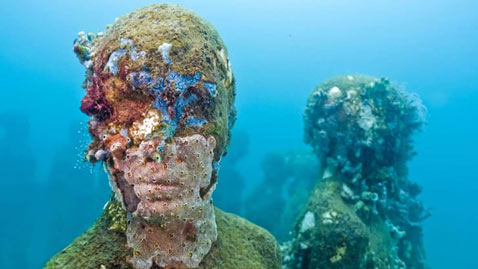
ht jason deCaires taylor 11 jp 110831 wblog Jason de Caires Taylor: Underwater Photography

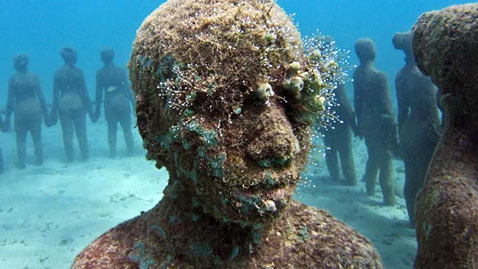
ht jason deCaires taylor 16 jp 110831 wblog Jason de Caires Taylor: Underwater Photography


Take a look at these.  Artist Jason de Caires Taylor crafted over 400 unique sculptures of humans, then placed them on the ocean floor.  These statues host coral.  They are an attempt to spread knowledge about coral's impending demise, and provoke action to prevent that possibility.

More pictures here:
http://abcnews.go.com/blogs/headlines/2011/09/jason-de-caires-taylor-blends-environmentalism-with-underwater-photography/

Google Alerts.

My Google Alerts have been on fire recently, with tons of great stories coming in.  Here's a selection of must-sees:

Factory Farming Conference
So maybe California is too far away for a field trip.  This is a little closer to home, only about 4.5 hours away.  It is the first ever conference to end factory farming.  Talks span from factory farming to animal welfare to public health.  The event sounds like it would be a nice complement to Eating Animals.  Even if we couldn't actually attend the conference, perhaps we could organize such an event at Duke?  
http://www.thisdishisvegetarian.com/2011/09/1972farm-sanctuary-hosts-first-ever.html

Breakfast
This short film is another take on factory farm life, from the animals prospective.  It goes through a little slice of life for Harriet the chicken, Eleanor the cow and Arthur the pig.  The juxtaposition of the narrator's calm voice, the generally whimsical pictures, and the harsh reality of each animal's existence is rather jarring.  At three minutes long, anyone can make time to watch the video.
http://www.treehugger.com/files/2011/09/dark-poignant-short-film-connects-breakfast-food-with-factory-farming.php

350.org Event
A small article about the 350.org event last weekend.  The article brings up a good point - there really was not much media coverage of the various Moving Planet demonstrations.  Admittedly, I don't have as much access to the news as I might like, but it's curious that such a large scale demonstration got swept under the rug.  Meanwhile, McKibben's arrest for the Tar Sands protest was documented.  Maybe big oil is in bed with big media, and together they are trying to drown out the voice of protesters?  Who knows?
http://www.earthisland.org/journal/index.php/elist/eListRead/the_day_the_people_moved_for_climate_and_big_media_turned_the_other_way

Take a look at the Flickr album for the 350.org event!  Lots of cool demonstrations out in the world!
http://www.flickr.com/photos/350org/sets/72157627713917562/

Solar Farm
Just thought it was fun that this article, about a potential solar farm in Nevada, came up in my "Factory Farming" alert.
http://www.lvrj.com/news/proposed-solar-factory-could-expand-laughlin-130491028.html?ref=028

Oh, Midterms.

In school, there are different teachers for every subject.  Some are relaxed, some are uptight, some are creative, some are cut and dry.  It's one of the best things about the system; there's always someone different waiting in the next class.  

So it always astounded me that all of my teachers could plan tests or papers for the same day.  One might think that with so many different kinds of people, these examinations would spread themselves out.  Alas, somehow they did not in high school, and they do not in college.  This weekend was rough.  Engineering lab due Monday, chemistry lab report due Tuesday, chemistry lab prelab/procedure due Tuesday, calculus exam Tuesday, rough draft Wednesday, all mixed in with classes, rowing, and other activities (sleeping is nice...).  I made a plan, an hour by hour plan, as to how I would spread this week's work out over the weekend.  This was abandoned within the hour, as errors in engineering code stretched later and later into the night.  Fast forward from Friday to Tuesday, and my paper remained untouched.  

It was a struggle of sorts, writing this paper, though this can mostly be attributed to my already fried brain and my time table.  I have every intention of coming back to it and completely rewriting certain sections that I know are weak.  I will be reading scientific journals to better understand the facts that back up my case, and will therefore be able to craft stronger arguments as a whole.  It will be better, simply because I will have time to write well.  The prompt is a little unwieldy. and the nature of the beast itself make the paper challenging  (research papers are different than English papers).  But it is very doable, and my writing will improve.

It's a process.  Let me process, and I will progress.

GMO Film Project

This is the project that first got me interested in genetically modified organisms and how they affect human health.  While it is certainly shows bias, it also contains some good facts.  I look forward to seeing it when it comes out.  I imagine it will be kind of like Eating Animals or Eaarth.  Informative, but difficult to take seriously do to the significant bias.   Watch the two videos if you get a chance.  They are entertaining, and they might even make you think a little bit.

http://gmofilm.com/

http://www.kickstarter.com/projects/1315201716/gmo-film-project-untitled

Thursday, September 22, 2011

Limitations

After the activities fair, I had a small mountain of papers, pamphlets, and propaganda sitting on my bed.  Every group, it seemed, managed to leave me with a sheet stating their name and the date of their first meeting.  Quickly I tired of sorting through the rubbish.  Instead, I ended up settled in, looking at all the books I’d picked up - magazines, journals, and anthologies produced by student organization.  I was flipping through Latent Image, a student photography publication, when I noticed the image below.  


Pretty picture, but one I have seen before.  The late night cityscape is a tired image, borderline cliché.  What makes this picture interesting is not the number of people up for midnight snacks with their lights shining, but the title.  The photographer named it Invincible.  Invincible to what?  The rural way of life?  The aching call of late night sleep?  The toll of time?  Power outages?  

What resonated most with me is a city impervious to outer pressure.  Throughout years and years, the city as the place of trade and education, as the place where culture is made, this model of a city has stayed constant.  It’s a hustling, bustling, busy area with everyone going to everything, everywhere.  A city will always be that sort of place, due to the sheer number of people who flock to cities every year.  As long as people want the city to stay the way it is, the citizen’s will insulates a city from change.  It will evolve internally, but only internally.

Because there will always be an abundance of bodies, there will be a constant need for energy to support them.  Food, water, shelter, and electricity are necessary for sustenance, survival, protection, and power.  These are human “needs” now.  If they are available, these amenities are desired and sought out.  How, then, does one go about breaking down this system?  How does someone, even someone with the best of intentions, walk into city life and expect to fundamentally change it?  According to Bill McKibben, to survive the impending climate apocalypse we, the citizens of the world, must become citizens of our own towns and villages again, and scale back from city life.  It seems sometimes an impossible task, taking down the current culture and replacing it with something so much less exciting.  In this way, the city seems invincible, with so many minds to change and things to build.  But maybe, just maybe, McKibben's view of the future can pass muster in the public eye.  Perhaps with enough concentrated effort, with enough strikes to fault lines and strokes to city pride, those in favor of local living can break down some city walls.  Maybe the city, the electricity, the destructive culture, isn't so invincible after all. 

We can't know until we try.

Image from: Latent Image 2011 Vol 31, page 24
Potentially Correct Image Citation: Kuo, Nina. "Invincible." Latent Image Vol. 31. 2011: 24. Print.

Wednesday, September 21, 2011

Saving Tigers One Stamp at a Time


First off, I want this tiger stamp as a poster.  It is adorable. 

Secondly, the stamp movement confuses me a little.  I like the idea, but it seems a bit out-dated.  Combine the extent of email with the amount of junk mail that doesn’t use stamps, and one wonders how much mail is sent every day that still uses stamps.  Stamps were once an essential part of daily life, to pay bills and communicate with those far away.  But now, with technological advances, stamps won’t be quite the money maker they were before.  The United States Postal Service is selling 5 million stamps for 55 cents/stamp, or $11 for a sheet of 20.  If all 5 million sell, it breaks down to about $78571 donated per animal.  Every little bit helps.  

As I said earlier, I like the idea, I like the way stamps look, and I still send letters.  I will be supporting this conservation effort.  Will you?

Sunday, September 18, 2011

Field Trip!

Perhaps a field trip to California is in order.  Duke could fund that, right?  For Bill Nye and Bill McKibben?


http://www.youtube.com/watch?v=9q5cV9u-yXg


http://www.youtube.com/watch?v=UDzZHdv1MlM&feature=relmfu

Musings on McKibben

Oh, McKibben.  You have successfully convinced me to move to Vermont after I finish my schooling.  Only there (or in third world Africa and Asia, which is a bit too hot for my taste) will I be “safe” after global warming ravages the planet.  See, McKibben gives a lot of arguments for why the world as we knew it has ended.  In fact, for 101 pages, he sites statistic and statistic and statistic again from reputable scientists, all with the same general message – the world is failing us because we have failed the world.  His presentation is effective; the mood following those first 101 pages is depressed and desolate.  The sheer amount of information is a blow to the head, shattering previously held confidences about the viability of current global warming initiatives.  Which is exactly what he wants, I would think.  Bringing people into an area of their world that they cannot hope to control, bombarding them with information about their eventual downfall… McKibben uses his first two chapters to bring readers into this “fear zone”.  Similar to that of a TV news station, or even a government looking to make people compliant, McKibben scares people into looking at his problem, and further into accepting it as their own problem.   It makes the reader unnerved and uncomfortable, which in turn makes them look for assistance.  This is far too large a problem for any one of them to fix.  Who can offer a solution?  Who can save the souls of man?

Why, McKibben can, with his 12 step plan for oil-holics.   While the problem of climate change is too large for just a single man to solve, McKibben has some good solutions.  The war on climate change must be fought, and every army needs a general.  McKibben is looking for a day job, how about him?  He would gladly take up the cross; heck, he already has.  Fascinating one man can make his life out of advocating environmental policy.  Anyway, that is enough ripping on McKibben, because he really does have some good solutions.  His biggest idea is the recreation of community atmospheres within cities, towns, and neighborhoods.  Through this, many of the potential problems presented by climate change can be solved.  If communities are growing their own food and supplying their own energy, suddenly the world doesn’t need oil tycoons or factory farms.  By becoming neighbors again, people need less stuff.  One vacuum can meet the cleaning needs of a whole street if it is shared.  He tries to inspire his reader to believe in his vision by providing examples of places where community has worked.  Many are admittedly in Vermont, his home state, like Farmer’s Diner, the Highfields Institute, Intervale Farms, Front Porch Forums, and Middlebury College.  But he diversifies, pulling from experiences in Bangladesh, Malawi, China, Indonesia, and Madagascar.  Just as in the first half of the book, McKibben bombards the reader with information, but this time it is in the form of anecdotes.  The massive amount of support for his idea is comforting, making it seem very possible to change the world.  Slowly, yes.  Painfully, yes.  But it is doable.  We, the readers, can have hope, should we begin to implement some of McKibben’s suggestions.  eaarth is a good read, similar to Jonathon Safran Foer’s Eating Animals in that it brings to light an issue in society that tends to get hidden away from view.  The book offers food for thought.  Local food, of course.