This was a longer section. Reindigenization spoke about what reindigenization is, and how it can be achieved.
The first story featured three men, Greg Cajete, John Mohawk, and Julio Valladolid Rivera. Mohawk says reindigenization is, "...to rebuild that which was there before [colonization] happened, both in the form of human cultures and in the form of bringin back the biodiversity that existed prior to the colonization" (254). Their topics were widespread, but a few general themes stood out. All three discussed the importance not just of education, but of the right kind of education. After Rivera's graduate school agricultural education, he had to spend years unlearning things so that he could commune with the plants again, and really listen to what they were telling him. It is important to be schooled in your own culture, and to learn the old ways so that you, too, can pass on the knowledge of your people, they say. The all talk about intellectual property rights, and whether they have any business existing at all. Rivera doesn't believe in them for living things, in part because companies take advantage of the generous nature and indigenous knowledge of the Andean campesinos to patent new species of plants. Mohawk doesn't like them for living things either, as the people claiming to invent the plant or the animal didn't actually invent that thing, the Creator did. Cajete calls the sanctity of life into question when one starts patenting it. A patent isn't showing respect to the plant, and that is wrong. Mohawk ends the section with a call to action, asking people to stop lazing around doing nothing and stand up to the murderous, rampaging culture that's been throwing rationality out on the street since 1450. We know it is there, we know it exists, so now we just need to figure out a way to neutralize it.
The second story is about ecopoetics and the importance of words. Speaker believes that language is the key to a communal mestizo consciousness. She also thinks poetry is the way to explain the "oneness" of all living creatures to people, and a good way to bridge the gap between people.
The third story, by Melissa K. Nelson, deals with the "trickster consciousness". She works with The Cultural Conservancy, and over the years they have been helping Indigenous Peoples record their knowledge to use in teaching tools and for preservation. She calls out binary thinking for invading our brains and not allowing us to see the whole story, and all of the connections between things. Nelson also gives a definition of reindigenization, "...reconnection to our cultural heritage and our native imagination" (293). A specific example, the Paiute Salt Song, is espoused, as a response to the boarding schools many Indians were forced to attend as the government attempted to make them "assimilate". Language, Nelson closes with, is what needs to be protected, because it holds all the land based practices; cultural knowledge is lost as natural resources and biodiversity are lost.
Tirso Gonzales tells the fourth story, a short piece about colonization. He begins by calling out European ways of thinking, for many of them are "anthropocentric and grounded in the Judeo-Christian and Cartesian cosmovision" (299). The importance of the individual over the group, and the lack of respect to the world around them anger Gonzales. He desires a return to ancient Indigenous Peoples' worldview, one where "sacredness, reciprocity, nurturing, and respect are key concepts..." (300). However, the Indigenous population is growing, and the number of people who no longer believe in these main European constructs is too.
Taro root is the subject of the fifth story. Three people, Mark Paikuli-Stride, Eric Enos, and Nalani Minton, talk about the Hawaiian indigenous culture. The native Hawaiians have lost much of their traditional land to the government or rich developers, yet they do the best with what they have. In an attempt to regain access to some of their lands, they are trying to share their culture with those around them, bring people back to the taro patches so that people will understand why these things are important. The history of the particular valley they discuss is laid out, from the barren and dead beginnings to the greenery and fertility of recently. Success here is helping heal the island, and open up minds to change.
The final story asks us whether or not we're being human beings. John Trudell asks us to thing clearly and coherently, and look at the world that we live in. We all have power, "...the individual experience of being and how that being evolves as we go through the human experience; this is what's connected to the realities of what power really is" (320). The things we view as power are just "systems of authority" (320). Trudell also calls hope evil, arguing that it did come out of Pandora's box of evil. It tricks people into being content and not thinking, just hoping. We need to think, not believe, because when we think, we can recognize life for what it is, and when we see what is in front of us, we cannot have that reality "mined" away from us.
Sunday, November 27, 2011

Decolonization Talking Points
Decolonization focused on colonization, and what needs to be done to avoid further hardship for Native Peoples. In the first story, Tome Goldtooth talks about his work with the Indigenous Environmental Network, which is a group of Indigenous people working for environmental and economic justice within North America. Traditional knowledge states that we have a responsibility to the land, we being all people, but especially the Indigenous peoples. Yet, due to the structure of today's society, the people charged most prominently with protecting the land have been stripped of their land, and must fight to protect what they still have. Goldtooth calls for all people to come together, as we are all of the same origin, and we are all related. Together, we would not need to fight each other for land or for knowledge (biopiracy makes a return in this section); instead, we would take care of each other and take care of our environment, because it is as much a part of us as we are to each other.
Ohki Simine Forest talks about her time in Chiapas, and the Zapatista revolution in 1994. In Mexico in 1994, the Zapatista people took up arms against the Mexican government, demanding they be heard. This was a fairly peaceful armed rebellion, as little blood was shed, but the strength of the action itself was enough to make a statement. The Mexican government was trying to change a law that gave the Zapatista their land rights. The government was committing other crimes against the Zapatista people (like ignoring a cease-fire agreement). As a movement, the rebellion got the Zapatista nowhere fast, yet their decision to fight their oppression has served as an inspiration to other Indigenous peoples. It also acted as a wake up call to the world. The Zapatista people were fighting for food, water, education, and health care, not for power. Forest emphasizes several times how humble these people are, wanting nothing but the basics, and having to provide those for themselves when the government refused. The uprising was prophecized long ago as the coming of the Plumed Snake to take back the land from the Smoking Mirror. There is also some talk about the council system of government, which Forest supports due to its inclusive nature (both of people and of topics).
Another member of the Indigenous Environmental Network gives the third story, about his own experiences. Clayton Thomas-Muller works with tribes to prevent the intrusion of oil and mining corporations on tribal lands. Indigenous peoples are some of the poorest in the country, and oil tycoons know it. Since oil and mining companies are running out of product in the obvious places, they are having to search farther and farther to get what they want and make a profit. Indigenous people suffer through constant cycles of abuse from the government, and corporations stride in, thinking they've got easy prey, and promise big gains in return for the land the Native people live on. Thomas-Muller attempts to mitigate or prevent agreements from being made by education tribes on the horrors drilling and mining have on sacred lands. It is a scathing persecution of capitalism and materialism, blaming the economic system not only for the current poor quality of land, air, and water, but also for the wars of the past century. What is interesting is that Thomas-Muller doesn't call for the downfall of capitalism. Instead, he wants to redefine it to be something better. To do this, communication and respect between all groups must be established, and everyone must sit down at the table. The summits cannot be just the super powers. All people must live with the decision, so all people must agree to the decision.
The last speech is a quick anecdote about a class trip to Richard DeerTrack's apple tree. His daughter brings her class over to his tree to pick an apple. DeerTrack sees this, and is inspired. He uses the quintessential "Save the Earth!" argument - do it for the kids. This isn't a bad argument, as this generations children will have to deal with the world we leave them, but it is a little tired, and a little overused. His take on it is refreshing, likely due to the exuberance evident in his writing. He really believes in this. The idea of corporate greed is brought up, but not much time is spent discussing it.
Ohki Simine Forest talks about her time in Chiapas, and the Zapatista revolution in 1994. In Mexico in 1994, the Zapatista people took up arms against the Mexican government, demanding they be heard. This was a fairly peaceful armed rebellion, as little blood was shed, but the strength of the action itself was enough to make a statement. The Mexican government was trying to change a law that gave the Zapatista their land rights. The government was committing other crimes against the Zapatista people (like ignoring a cease-fire agreement). As a movement, the rebellion got the Zapatista nowhere fast, yet their decision to fight their oppression has served as an inspiration to other Indigenous peoples. It also acted as a wake up call to the world. The Zapatista people were fighting for food, water, education, and health care, not for power. Forest emphasizes several times how humble these people are, wanting nothing but the basics, and having to provide those for themselves when the government refused. The uprising was prophecized long ago as the coming of the Plumed Snake to take back the land from the Smoking Mirror. There is also some talk about the council system of government, which Forest supports due to its inclusive nature (both of people and of topics).
Another member of the Indigenous Environmental Network gives the third story, about his own experiences. Clayton Thomas-Muller works with tribes to prevent the intrusion of oil and mining corporations on tribal lands. Indigenous peoples are some of the poorest in the country, and oil tycoons know it. Since oil and mining companies are running out of product in the obvious places, they are having to search farther and farther to get what they want and make a profit. Indigenous people suffer through constant cycles of abuse from the government, and corporations stride in, thinking they've got easy prey, and promise big gains in return for the land the Native people live on. Thomas-Muller attempts to mitigate or prevent agreements from being made by education tribes on the horrors drilling and mining have on sacred lands. It is a scathing persecution of capitalism and materialism, blaming the economic system not only for the current poor quality of land, air, and water, but also for the wars of the past century. What is interesting is that Thomas-Muller doesn't call for the downfall of capitalism. Instead, he wants to redefine it to be something better. To do this, communication and respect between all groups must be established, and everyone must sit down at the table. The summits cannot be just the super powers. All people must live with the decision, so all people must agree to the decision.
The last speech is a quick anecdote about a class trip to Richard DeerTrack's apple tree. His daughter brings her class over to his tree to pick an apple. DeerTrack sees this, and is inspired. He uses the quintessential "Save the Earth!" argument - do it for the kids. This isn't a bad argument, as this generations children will have to deal with the world we leave them, but it is a little tired, and a little overused. His take on it is refreshing, likely due to the exuberance evident in his writing. He really believes in this. The idea of corporate greed is brought up, but not much time is spent discussing it.
Wednesday, November 23, 2011
You Are Where You Eat Talking Points
You Are Where You Eat, in contrast, was exactly what I thought it would be. The authors said more of the same on what we've already heard from Eating Animals, Food Inc., and bits of eaarth and Jensen's speech. Things it highlighted include the greater variety of foods available to Indigenous People, how the variety allowed them to be a healthier, heartier people, how the community aspect of Indigenous life made people very aware of what they ate, how they grew it, and how they ate it. We hear again about how a return to native food sources can resurrect old feelings of responsibility to ourselves and to the land, and return us to a vibrant, sustainable, healthy lifestyle. With more variety of plant and animal life, we are more likely to have options when climate change starts hitting the food supply hard, because we'll have plants for droughts and floods. I can understand why Dr. Taylor didn't want to waste time with a discussion on this section. It is because it is all stuff we have already heard. There are some semi-new ideas, but these are mainly old ideas verbalized. You Are Where You Eat offers little new to chew on.
Feminine Power Talking Points
This section was not what I thought it was going to be. Hearing the title, I assumed a section centered on female empower, something more like ecofeminisim. While there was some talk about female gods, female relationships, and the 'othering' of women and nature, the section didn't really focus on these. It was one of the weaker sections for me, without the central theme I saw in some of the others. The first story was about the power of a female god, one where you don't save the world to save the world and preserve yourself, you do it because She told you to. The second story is about the empowerment of Ethiopian women against female genital excision. the women are working to get rid of this cultural practice, for the betterment of all involved. The final story talked about a Mohawk reservation in the Great Lakes Region, where toxic waste had been built up on a riverbank and was polluting water sources. This pollution got into the food supply, and in turn found its way into women's breast milk. It discusses the fight to remediate this biohazard for the health of the women there. Maybe I just didn't "get" it.
Kinship Talking Points
This section primarily spoke of relationships, both people to people relationships and those between people, plants, animals, and the Earth. In the times of old, it is said that people and animals could talk together, and they formed contracts of behavior based on mutual respect. Certain Indigenous peoples believe that the world is crashing because these contracts are being ignored as the Western tendency to "other" natural things spreads. These contracts allowed humans to harvest animals and plants for food and other goods, but in turn humans did good to the animals and plants. Humans are presented as a keystone species, one that controls part of their environment due to the role they play. Many examples of this are given, including the clam beds of California, the Chinook salmon runs, the Oregon forests, and the hunting of elk (91-92). Indigenous people showed respect to the creatures they took, putting all parts of a dead animal or plant to use.
Ownership of the land is discussed, as is the need for a sense of responsibility to the land on which you live. In one section, the fight for good water quality on a pueblo in New Mexico is chronicled. It is amazing how much the city of Albuquerque fought Islata pueblo on water quality standards. The pueblo needed clean water for food, for water, and for religious ceremonies, yet the city of Albuquerque was more concerned with how the new standards would affect businesses and costs than people's health. The connection between people has been severed, and the sense of responsibility to each other lost.
Again the importance of language was brought up, in quotes like, "You can always read the science in the literature, but you're not going to get much of what Indigenous Peoples have to offer about their unique perspectives unless you hear it from them directly" (89), and "When we preserve and pickle, or do what some ethnoecologists or anthropologists do (take this knowledge), they have to translate it. They have to transform the knowledge and they take it out of its context" (100). To gather the knowledge of the Indigenous peoples, we need to learn their languages, or at the very least learn how to understand their metaphors. Otherwise, we will not be able to adopt their practices.
Ownership of the land is discussed, as is the need for a sense of responsibility to the land on which you live. In one section, the fight for good water quality on a pueblo in New Mexico is chronicled. It is amazing how much the city of Albuquerque fought Islata pueblo on water quality standards. The pueblo needed clean water for food, for water, and for religious ceremonies, yet the city of Albuquerque was more concerned with how the new standards would affect businesses and costs than people's health. The connection between people has been severed, and the sense of responsibility to each other lost.
Again the importance of language was brought up, in quotes like, "You can always read the science in the literature, but you're not going to get much of what Indigenous Peoples have to offer about their unique perspectives unless you hear it from them directly" (89), and "When we preserve and pickle, or do what some ethnoecologists or anthropologists do (take this knowledge), they have to translate it. They have to transform the knowledge and they take it out of its context" (100). To gather the knowledge of the Indigenous peoples, we need to learn their languages, or at the very least learn how to understand their metaphors. Otherwise, we will not be able to adopt their practices.
Wednesday, November 16, 2011
Indigenous Democracies Talking Points
Things I noticed in this section:
- Power of culture to control society
- The Iroquois culture was so powerful, there was no chaos. We have so many different cultures, with so many intolerances that it seems impossible to return to a culture that powerful. Yet, at the same time, we have capitalism sitting over us, over everything, directing our actions. Capitalism sets us against each other, which sets up the problems between societies - capitalism and religion, I guess.
- Setting of violence within a society
- "The cycles of violence were deeply embedded in the laws and customs of the Indian people, and they were about revenge, for real and imagined injuries," (55) This reminds me of Jensen and his cycles of violence. Violence against women, violence against each other, both are allowed in today's society. " How people are treating one another in the world has no relationship at all to thinking about how we sustain human life on the planet," (57). This reflects on the lose of community in society.
- "What we do to each other, we do to the Earth"
- Jensen again!
- Democracy was first an Indigenous practice.
- The Indigenous people were the ones who taught "Americans" how to have democracy. Slowly this has been lost over time. In Indigenous society, everyone votes and takes part in the decision making process. They use consensus, and the notions of justice, peace, and unity. They picked their leaders with a long, involved process, and if even one person had a problem with a prospective leader, that person wasn't chosen. That isn't how it works in Western society.
Connection to Nature
Eco-spirituality is presented here as a many faceted thing. It is incorporated into all aspects of Indigenous life. At its most base level, it seems to be an appreciation of what is around you, and a respect for the land.
My own connection to nature is also multi-faceted. The idea that we can distill down how we relate to our environment to a few sentences is an impossibility. I guess one thing I could pull out is enveloping my mind in nature through sport. Whenever I go out in a boat to row, or dive into a pool to swim, even on a trail run, my mind just goes blank. Everything drifts out of my mind and I find the most perfect peace.
Eco-Spirituality Talking Points
Some things I picked up on in the eco-spirituality section
- Importance of Language and Oral Traditions
- Indigenous knowledge seems to be passed down orally, which means the words chosen to express ideas become very important. The combination of the chosen words and the style of oratory make the learning experience what it is. Oral traditions are also more open to change than written traditions, which offers more flexibility. There are instances where Indigenous people "other" themselves. For example, page 23, "They will suffer." Does this mean that the Indigenous people believe they will be exempt from the problems, since they didn't cause it?
- Women in Power
- Mother Earth is referred to (26, 49), as is the women's council (27). The word mother inspires respect for the vessel, which may be why society is so resistant of the idea all together. The women's council ruled in Cherokee Nation during times of piece, while men ruled during times of war. Giving power to women is "othered" to some extent in our society.
- Role of Science vs. Indigenous Knowledge
- Science steals from Indigenous Knowledge through "biopiracy." Why is this sort of action plagiarism in academia, but okay here?
- Indigenous knowledge is used to make all decisions as a community. How is it that Indigenous people can make decisions in this manner, while our Congress resorts to blatant lies to get what they desire?
- Community
- Idea of "home" and community are scattered throughout this chapter (ex, pg 23, 25). Have we lost the idea of home? We don't know where we live, we don't connect with our physical homes.
- Capitalism's role in values of today's society
- Quote on page 33 - "What made traditional economies so radically different...sustainability vs growth," is a nice juxtaposition of the two differing economic theories.
- "You have to raise your own leaders," pg 24
Nanabozhoo - the short version
What would be gained or what would be lost by making Nanabozhoo your creation myth?
I figure I wouldn't gain or lose much by switching creation figures, no more than when I switched from creationism to evolution. As a believer in science, evolution makes the most sense. Nanabozhoo is a variation of the creationist "mythology". Nanabozhoo seems to be a combination of the roles Jesus, Adam, and God play in Catholicism. Jesus was born of a woman and a spirit, as is Nanabozhoo. Adam names all the plants and animals, just as Nanabozhoo. God created the world, as does Nanabozhoo. Nanabozhoo is used as a teacher figure within his stories, while Jesus tells stories. The curious thing is that Jesus never uses himself within his stories always other, generic people. Perhaps Nanabozhoo is a more relatable figure, because he makes mistakes and he isn't perfect? Then again, does society want to listen to someone less than perfect?
I don't have my book with me, so I can't make many more "justifications", only speculate on the similarities.
I figure I wouldn't gain or lose much by switching creation figures, no more than when I switched from creationism to evolution. As a believer in science, evolution makes the most sense. Nanabozhoo is a variation of the creationist "mythology". Nanabozhoo seems to be a combination of the roles Jesus, Adam, and God play in Catholicism. Jesus was born of a woman and a spirit, as is Nanabozhoo. Adam names all the plants and animals, just as Nanabozhoo. God created the world, as does Nanabozhoo. Nanabozhoo is used as a teacher figure within his stories, while Jesus tells stories. The curious thing is that Jesus never uses himself within his stories always other, generic people. Perhaps Nanabozhoo is a more relatable figure, because he makes mistakes and he isn't perfect? Then again, does society want to listen to someone less than perfect?
I don't have my book with me, so I can't make many more "justifications", only speculate on the similarities.
Confusion...
Write about one aspect of Prechtel's speech that was unclear or underdeveloped
It seems strange to Westerners now because they have systematically devalued the other world and no longer deal with it as part of their everyday lives.
- result of European totalitarianism - divine rule - destruction of other cultures - interested in the spread of Catholicism - know how it came to the Americas, but how did it spread throughout Europe when it originated in the Middle East?
Some of us have buried our humanity deep inside, or medicated or anesthetized it, but every person alive today, tribal or modern, primal or domesticated, has a soul that is original, natural, and, above all, indigenous in one way or another.
- reminds me of every distopia I've ever read - are we living in a distopia?
But all along the way, very little, if anything, was given back to the hungry, invisible divinity that gave people the ability to invent those cars. Now, in a healthy culture, that’s where the shamans would come in, because with every invention comes a spiritual debt that must be paid, either ritually, or else taken out of us in warfare, grief, or depression.
- This comes back to the the God-apple debate, from a different prospective. Why did God make the apple if he knew it would tempt Adam and Eve? Why did the deities give us the ability to dream if it costs them such? Is this a sort of parent-child dynamic? Parents sacrifice for their child so their child can repay them?
Ideally, the gift should be something made by hand, which is the one thing humans have that spirits don’t.
- How does that work? Are we supposed to make something and bury it? How does song play into this if song is not made by hand? If we make something, is the simple act of making it enough, or does it have to made with the spirits in mind?
It seems strange to Westerners now because they have systematically devalued the other world and no longer deal with it as part of their everyday lives.
- result of European totalitarianism - divine rule - destruction of other cultures - interested in the spread of Catholicism - know how it came to the Americas, but how did it spread throughout Europe when it originated in the Middle East?
Some of us have buried our humanity deep inside, or medicated or anesthetized it, but every person alive today, tribal or modern, primal or domesticated, has a soul that is original, natural, and, above all, indigenous in one way or another.
- reminds me of every distopia I've ever read - are we living in a distopia?
But all along the way, very little, if anything, was given back to the hungry, invisible divinity that gave people the ability to invent those cars. Now, in a healthy culture, that’s where the shamans would come in, because with every invention comes a spiritual debt that must be paid, either ritually, or else taken out of us in warfare, grief, or depression.
- This comes back to the the God-apple debate, from a different prospective. Why did God make the apple if he knew it would tempt Adam and Eve? Why did the deities give us the ability to dream if it costs them such? Is this a sort of parent-child dynamic? Parents sacrifice for their child so their child can repay them?
Ideally, the gift should be something made by hand, which is the one thing humans have that spirits don’t.
- How does that work? Are we supposed to make something and bury it? How does song play into this if song is not made by hand? If we make something, is the simple act of making it enough, or does it have to made with the spirits in mind?
Tuesday, November 8, 2011
Prechtel's Piece
To start off, I'm going to acknowledge my bias. I like Prechtel. I like his story. I like his way of thinking. He seems like the type of guy somebody might pick to have dinner with when people ask, "If you could have dinner with anyone in the world, dead or alive, who would you pick?"
If it makes any difference, I listened to the audio first. His way of thinking was roundabout, but sensible. What he said about grief and praise being the same thing seemed so paradoxical and yet so simple. It was beautiful, eloquent. I'm sure some spirits fed well on that 5:oo minute clip. What was most striking to me was the everything matters attitude he held. We must be aware of our own mortality to appreciate that which we have - if we believe we'll live forever, we are never satisfied, as we are always seeking out the next best thing. Because our lives are finite, everything matters, and some things matter more than others. The Mayans lived their lives on highs and lows, bringing the stakes of their everyday lives up and up until anything worth praising was worth it because without the good the praise worthy were doing, the world would shatter. This makes our mindset feel so...trivial. The things we praise are not worthy of praise, because we praise for self-preservation or self-promotion. Instead of trying to accept grief and pain and loss into our lives as the healthy states they are, we fight them, marginalize them, rationalize them away. Without one, we cannot appreciate the other. It reminds me very much of the saying, "The opposite of love isn't hate. It is indifference." The Mayans lived passionately, from the sounds of Prechtel, while modernists live indifferently, fighting for permanent balance over equilibrium.
In Jensen's essay, I couldn't help but be reminded of His Dark Materials, by Philip Pullman. The other world, the ghosts eating the lives of people, the spirits, debt. It reminds me of Spectors and Dust and harpies. I found it curious exactly how much Prechtel's responses reminded me of these books. I also found the concept of a language without to be intriguing. We rely so much on to be to determine who we are. It defines us. It separates us. Since language builds the world, how different might things be without to be? There might be more community, as we couldn't be anything other than what is around us. We would be defined not by what we did or who we were, but by that with which we surrounded ourselves.
Prechtel's words make sense. The part about the Mayan huts reminded me of eaarth and Bill McKibben. We no longer help each other, so we are unable to act as neighbors to each other, we cannot connect. The part about oral tradition and a sense of place reminds me of the entire last unit. The part about cutting out the natural part of ourselves to fit within the rational, logical, science-based box of modern society reminds me of Jensen and some of the other essays we've read. Prechtel's way of viewing the Earth and the relationships of the Earth work within the parameters that are laid out - they fit the issues the world is facing, offer explanation. I find myself believing I need to find my ancestors and properly mourn them. Why not? It makes as much sense as any other options. Maybe that's the beauty in it. Mayan spiritual beliefs answer as many questions as science or religion. They should have just as good a shot in fixing our problems, right?
** I apologize for the poor nature of the piece. Stream of consciousness is never my best work. I need to practice more. I also hate that there is no "no high lite' option in Blogger. Thanks Google.
Spirit Bear

The spirit bear video is difficult to analyze. I feel like there is more there than I am catching in the 2:xx clip.
As a species, the viability of an animal created solely through the chance meeting of two bears with a recessive gene is low. It isn’t stated in the video, but I wonder if the spirit bear can mate and form other spirit bears, or if they can only be produced through luck – first through two black bears with an inner white bear, and second by falling into the 25% chance that these recessive alleles will combine. It just seems highly unlikely, hence why there are only 400 bears left. Also, with only phenotypic differences, are they really a new species, or are they just a variation, like an albino? From the video, it seems like they really are just white black bears.
While a white black bear is very cool, I don’t see why they are absolutely necessary. Species go extinct all the time, due to habitat erosion, lack of food, disease, hunting. The phenomena of extinction has been going on for hundreds of thousands of years, and it will continue, no matter how we try to stop it (for the most part, we help, it seems). One day, we will go extinct, regardless of how we fight it. Natural cycles stand still for no man, no beast, no plant. This isn’t even a genetically unique type of bear – it’s an anomaly. Not to be coarse, but there are larger wildlife related problems out there. Why are we trying to solve this one?
Image from: http://www.spiritbear.com/
Friday, October 21, 2011
Brand Response
Another environmentalist, another set of views. We've heard from McKibben and Jensen, we've watched Food Inc. and TED talks, we've read books and articles galore. Now we listen to another old man, with another book, express another plan to salvage the world.
What I noticed watching the Brand talk was how much alike the others he is. He relies on logical argument, akin to McKibben, but is an emphatic speaker like Jensen. There's some of the shock tactic of Food Inc. and some of the guilt trip of the Native American TED talk, combined with the myriad of factual data from eaarth and musings on the future from various articles. What has become apparent in this journey through the land of environmental literature is how easy it is to make an argument for anything, and how difficult it is to figure out who to believe. It seems there is scientific data out there for any future situation you might desire. While some consistencies exist (i.e. climate change will take away our current home, we have to adapt, we cannot depend on fossil fuels any longer, community is key), the "how" of the matter is up in the air.
This ambiguity may be the downfall of the environmental movement. With such strong opposition to reform raining down from big oil, big agriculture, and anyone who identifies Republican, some form of united front is necessary to invoke change at appropriate levels. With so many tracks coming out of the movement, with so many solutions, it is easy for confusion and mis-information to spread. The generalizations grow, and paint a very unfriendly picture - people who hate oil, who hate coal, who want a return to the "Old'n Days". That image is not one people want to get behind, because it messes with their position in the world. The transition to a sustainable society seems so large as to be insurmountable.
That same quality is also environmentalism's greatest strength, however. With so many options, each and every one should be explored in some capacity. Maybe we don't dissolve society at large as Jensen suggests, but we do return to more natural ways of living - get in touch with our inner native. As Brand says, solar and wind can't save the world, but that doesn't mean we can't use some. It seems that everyone (except those whose way of life will be destroyed by a transition - big oil, big ag) should be able to find some way to be environmental.
Brand's speech touched on a lot of issues, ranging from geoengineering to genetic modification to nuclear energy (those were his main claims, after all). He uses a very dry rhetoric, delivering his ideas in a matter-of-fact type of way. He very much tried to take the emotion out of the issue, by not getting angry or exaggerating. Brand is...pragmatic. I agree with him that nuclear is necessary - it seems the only thing that can realistically provide the energy to the growing world. I agree that GMO's are necessary - though I strongly believe in regulation of the process. Geoengineering will likely be used - people can't resist trying to control the world. Cities are green - eh, I don't want to live in a city (I like my space). But the rationale makes sense. I would write more, but this discussion is too intense to have my attention split.
Brand's speech touched on a lot of issues, ranging from geoengineering to genetic modification to nuclear energy (those were his main claims, after all). He uses a very dry rhetoric, delivering his ideas in a matter-of-fact type of way. He very much tried to take the emotion out of the issue, by not getting angry or exaggerating. Brand is...pragmatic. I agree with him that nuclear is necessary - it seems the only thing that can realistically provide the energy to the growing world. I agree that GMO's are necessary - though I strongly believe in regulation of the process. Geoengineering will likely be used - people can't resist trying to control the world. Cities are green - eh, I don't want to live in a city (I like my space). But the rationale makes sense. I would write more, but this discussion is too intense to have my attention split.
Thursday, October 20, 2011

Picking a New Place?
These past few weeks, I have been studying Iceland, and it is a great place. It is a place I would love to visit, a place I strongly hope holds true to its ideals and traditions, a place that lends itself to environmental study. Therein lies the issue I am facing. Iceland doesn't fit the model. It is not a "town" as the Place-Based Landscape Analysis prefers, nor is it in dire need of repair. Iceland is sitting pretty atop the pile when it comes to environmental concerns. This makes me wonder if it is appropriate to the task at hand. Would it be a good idea to focus in on a town in Iceland, like Reykjavik, or to pick a new place entirely? I am uncertain as to how to proceed.

Were I to pick a new place, it would be the Big Darby Creek Watershed in central Ohio. Big Darby Creek is a National Scenic River, 82 miles long. It runs through 4 counties, and is home to a variety of fish, mussel, and plant species found scarcely elsewhere in the world. The watershed itself contains 6 counties. Much of the land in the watershed is agricultural, however, which leads to environmental problems like sedimentation and eutrophication (due to fertilizer run-off). As on of the Nature Conservatory's "Last Great Places", this area must be protected, to preserve biodiversity, and land health. It also happens to be on of the most "tested" rivers in the United States, meaning there will be plenty of available information.
What do you think?
Reykjavik?

Or the Big Darby?

Information came from my own knowledge and the EPA Environmental Assessment (http://cfpub.epa.gov/ncea/cfm/recordisplay.cfm?deid=15201)
Images from:
http://facweb.arch.ohio-state.edu/sgordon/research/darby/bdlu99map.html
http://www.thehisandhersblog.com/2011_05_01_archive.html
http://www.nature.org/ourinitiatives/regions/northamerica/unitedstates/ohio/placesweprotect/darby-creek-watershed.xml
http://accad.osu.edu/womenandtech/2005/Research%20Web%20Pages/History/Index.html
Were I to pick a new place, it would be the Big Darby Creek Watershed in central Ohio. Big Darby Creek is a National Scenic River, 82 miles long. It runs through 4 counties, and is home to a variety of fish, mussel, and plant species found scarcely elsewhere in the world. The watershed itself contains 6 counties. Much of the land in the watershed is agricultural, however, which leads to environmental problems like sedimentation and eutrophication (due to fertilizer run-off). As on of the Nature Conservatory's "Last Great Places", this area must be protected, to preserve biodiversity, and land health. It also happens to be on of the most "tested" rivers in the United States, meaning there will be plenty of available information.
What do you think?
Reykjavik?
Or the Big Darby?
Information came from my own knowledge and the EPA Environmental Assessment (http://cfpub.epa.gov/ncea/cfm/recordisplay.cfm?deid=15201)
Images from:
http://facweb.arch.ohio-state.edu/sgordon/research/darby/bdlu99map.html
http://www.thehisandhersblog.com/2011_05_01_archive.html
http://www.nature.org/ourinitiatives/regions/northamerica/unitedstates/ohio/placesweprotect/darby-creek-watershed.xml
http://accad.osu.edu/womenandtech/2005/Research%20Web%20Pages/History/Index.html
Kahn's Piece of Work
"It is predicated first and foremost by competition and growth, a predatory survival of the fittest approach to life in which "fittest" means most mighty and therefore able to grow further and out-compete rivals" (2)
This quote comes from Towards Ecopedagogy, a treatise written by Richard Kahn of Antioch University in Los Angeles. Here, "It" refers to capitalism. Kahn is a Marxist, so his anti-Capitalism stance is expected. Kahn, while dense throughout much of his paper, could not have made his meaning clearer in this case. Capitalism thrives on “competition and growth,” requires these conditions for survival. A stagnant capitalist society cannot exist. It is a predatory economic model by nature, asking followers to blindly consume others in order to progress. Destruction of rivals is a necessary part of the system. The “most fit” individual in a capitalist society is the one who can, “grow further and out-compete rivals,” or the one who is most willing to throw compassion and empathy away in favor of monetary gain.
Iceland is not capitalist with a capital C. It, according to the FBI World Factbook, “…combines a capitalist structure and free-market principles with an extensive welfare system.” Most of the exports are fish, or fish products, and there really is not a lot of agriculture or industrial production. As such, some of the worse facets of capitalism, like the dehumanization of workers, the efficiency model, and the sometimes dire working conditions have not affected Icelandic citizens as they have citizens of more “capitalist” countries. Iceland needs to remember its history. One of the big industries in Iceland is tourism, and there is pressure coming from within to commercialize some of the natural landscapes, so as to attract more travelers. In my eyes, doing so would take away from the “Icelandic experience,” if you will. In commercializing, the natural, untouched beauty of the land would be hindered, creating less of a reason to go there. The “improved” spaces would lose their escapism. Iceland should remember and see the uniqueness of its current position, and resist the likely attempts by capitalists to ruin that which makes it special.
Citation:
"Europe: Iceland." Welcome to the CIA Web Site - Central Intelligence Agency. Central Intelligence Agency. Web. 20 Oct. 2011 <https://www.cia.gov/library/publications/the-world-factbook/geos/ic.html>.
Sunday, October 16, 2011
Artifact for 10/12

Iceland is a unique nation, in that it is not facing many of the problems bearing down on others. A relatively small population means overcrowding is avoided, along with the public health and food supply issues that come with it. Vast supplies of geothermal energy, and effective use of hydropower allow lesser use of fossil fuels. The Icelandic government controls the fishing grounds surrounding its borders, and sets quotas and regulations on fishing practice, thus preventing major depletion of fish resources. Soil erosion is a problem, due to overgrazing from sheep and horses, but due to the absence of major agriculture, levels of erosion would be considered minor compared to larger agriculture nations. I thought this image, of Icelandic cottages built into the hillside with "green roofs", was fitting, as it exemplifies the Icelandic attitude towards the land: live with the land, take care of the land, and protect the land, because it is our home.
Information from:
"Iceland." OECD. Organization for Economic Co-operation and Development, n.d. Web. 12 Oct 2011. <http://www.oecd.org/dataoecd/8/63/2449047.pdf>.
Image from:
http://total-wallpapers.com/free-photography-wallpapers/green-rooftops-iceland-wallpaper-2815
Saturday, October 1, 2011
My "Place"
Does anyone know where this is?
How about this?

Or this, maybe?

They are all from the same place...the country's flag looks like this:

Any guesses?
One last hint:

These are all pictures of Iceland, my "place based education" pick! Iceland is a beautiful island, slightly smaller than the state of Kentucky, with a population of 311058 people. Nearly 2/3 of the population lives in the capital city, Reykjavik. The nation has somehow kept its natural beauty, which is fascinating given the pressure to expand. Iceland seems like it has an interesting story to tell.
Photos from: http://www.icelandviking.com/, http://www.equidblog.com/2010/09/articles/test-category/outbreaks-1/iceland-outbreak-slowing-down/, http://www.tripadvisor.com/Tourism-g189952-Iceland-Vacations.html, http://www.trekearth.com/gallery/Europe/Iceland/Nordhurland_Eystra/Eyjafjardharsysla/thjorsa/photo98643.htm
Factual Information from: https://www.cia.gov/library/publications/the-world-factbook/geos/ic.html#top
P.S. I apologize for the funky fonts. I'm not quite sure what's going on with the background coloring, and try as I might I cannot get it to go back to neutral.
How about this?
Or this, maybe?
They are all from the same place...the country's flag looks like this:
Any guesses?
One last hint:
These are all pictures of Iceland, my "place based education" pick! Iceland is a beautiful island, slightly smaller than the state of Kentucky, with a population of 311058 people. Nearly 2/3 of the population lives in the capital city, Reykjavik. The nation has somehow kept its natural beauty, which is fascinating given the pressure to expand. Iceland seems like it has an interesting story to tell.
Photos from: http://www.icelandviking.com/, http://www.equidblog.com/2010/09/articles/test-category/outbreaks-1/iceland-outbreak-slowing-down/, http://www.tripadvisor.com/Tourism-g189952-Iceland-Vacations.html, http://www.trekearth.com/gallery/Europe/Iceland/Nordhurland_Eystra/Eyjafjardharsysla/thjorsa/photo98643.htm
Factual Information from: https://www.cia.gov/library/publications/the-world-factbook/geos/ic.html#top
P.S. I apologize for the funky fonts. I'm not quite sure what's going on with the background coloring, and try as I might I cannot get it to go back to neutral.
Thursday, September 29, 2011
Road Trip!

Bill McKibben is hosting yet another Tar Sands protest on Sunday November 6 in Washington D.C. The plan is to encircle the White House, as a reminder to President Obama that his power lies in the hands of his voters, and of his promises to free America "from the tyranny of big oil". D.C. is only 4-5 hours away from Duke. Maybe we could send a group up to join the circle.
More information: http://www.tarsandsaction.org/
Image from: https://www.facebook.com/TarSandsAction
Sculpture
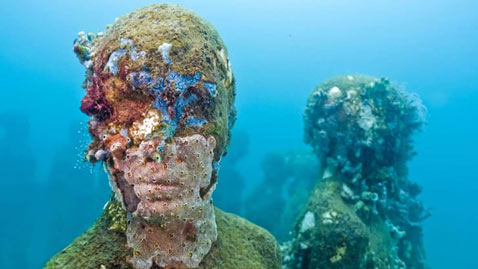
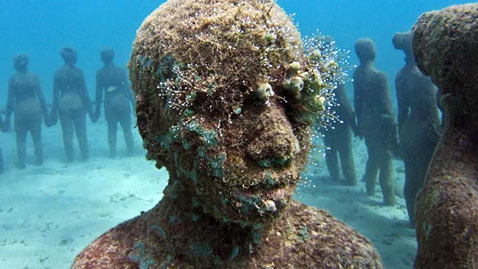
Take a look at these. Artist Jason de Caires Taylor crafted over 400 unique sculptures of humans, then placed them on the ocean floor. These statues host coral. They are an attempt to spread knowledge about coral's impending demise, and provoke action to prevent that possibility.
More pictures here:
http://abcnews.go.com/blogs/headlines/2011/09/jason-de-caires-taylor-blends-environmentalism-with-underwater-photography/
Google Alerts.
My Google Alerts have been on fire recently, with tons of great stories coming in. Here's a selection of must-sees:
Factory Farming Conference
So maybe California is too far away for a field trip. This is a little closer to home, only about 4.5 hours away. It is the first ever conference to end factory farming. Talks span from factory farming to animal welfare to public health. The event sounds like it would be a nice complement to Eating Animals. Even if we couldn't actually attend the conference, perhaps we could organize such an event at Duke?
http://www.thisdishisvegetarian.com/2011/09/1972farm-sanctuary-hosts-first-ever.html
Breakfast
This short film is another take on factory farm life, from the animals prospective. It goes through a little slice of life for Harriet the chicken, Eleanor the cow and Arthur the pig. The juxtaposition of the narrator's calm voice, the generally whimsical pictures, and the harsh reality of each animal's existence is rather jarring. At three minutes long, anyone can make time to watch the video.
http://www.treehugger.com/files/2011/09/dark-poignant-short-film-connects-breakfast-food-with-factory-farming.php
350.org Event
A small article about the 350.org event last weekend. The article brings up a good point - there really was not much media coverage of the various Moving Planet demonstrations. Admittedly, I don't have as much access to the news as I might like, but it's curious that such a large scale demonstration got swept under the rug. Meanwhile, McKibben's arrest for the Tar Sands protest was documented. Maybe big oil is in bed with big media, and together they are trying to drown out the voice of protesters? Who knows?
http://www.earthisland.org/journal/index.php/elist/eListRead/the_day_the_people_moved_for_climate_and_big_media_turned_the_other_way
Take a look at the Flickr album for the 350.org event! Lots of cool demonstrations out in the world!
http://www.flickr.com/photos/350org/sets/72157627713917562/
Solar Farm
Just thought it was fun that this article, about a potential solar farm in Nevada, came up in my "Factory Farming" alert.
http://www.lvrj.com/news/proposed-solar-factory-could-expand-laughlin-130491028.html?ref=028
Factory Farming Conference
So maybe California is too far away for a field trip. This is a little closer to home, only about 4.5 hours away. It is the first ever conference to end factory farming. Talks span from factory farming to animal welfare to public health. The event sounds like it would be a nice complement to Eating Animals. Even if we couldn't actually attend the conference, perhaps we could organize such an event at Duke?
http://www.thisdishisvegetarian.com/2011/09/1972farm-sanctuary-hosts-first-ever.html
Breakfast
This short film is another take on factory farm life, from the animals prospective. It goes through a little slice of life for Harriet the chicken, Eleanor the cow and Arthur the pig. The juxtaposition of the narrator's calm voice, the generally whimsical pictures, and the harsh reality of each animal's existence is rather jarring. At three minutes long, anyone can make time to watch the video.
http://www.treehugger.com/files/2011/09/dark-poignant-short-film-connects-breakfast-food-with-factory-farming.php
350.org Event
A small article about the 350.org event last weekend. The article brings up a good point - there really was not much media coverage of the various Moving Planet demonstrations. Admittedly, I don't have as much access to the news as I might like, but it's curious that such a large scale demonstration got swept under the rug. Meanwhile, McKibben's arrest for the Tar Sands protest was documented. Maybe big oil is in bed with big media, and together they are trying to drown out the voice of protesters? Who knows?
http://www.earthisland.org/journal/index.php/elist/eListRead/the_day_the_people_moved_for_climate_and_big_media_turned_the_other_way
Take a look at the Flickr album for the 350.org event! Lots of cool demonstrations out in the world!
http://www.flickr.com/photos/350org/sets/72157627713917562/
Solar Farm
Just thought it was fun that this article, about a potential solar farm in Nevada, came up in my "Factory Farming" alert.
http://www.lvrj.com/news/proposed-solar-factory-could-expand-laughlin-130491028.html?ref=028
Oh, Midterms.
In school, there are different teachers for every subject. Some are relaxed, some are uptight, some are creative, some are cut and dry. It's one of the best things about the system; there's always someone different waiting in the next class.
So it always astounded me that all of my teachers could plan tests or papers for the same day. One might think that with so many different kinds of people, these examinations would spread themselves out. Alas, somehow they did not in high school, and they do not in college. This weekend was rough. Engineering lab due Monday, chemistry lab report due Tuesday, chemistry lab prelab/procedure due Tuesday, calculus exam Tuesday, rough draft Wednesday, all mixed in with classes, rowing, and other activities (sleeping is nice...). I made a plan, an hour by hour plan, as to how I would spread this week's work out over the weekend. This was abandoned within the hour, as errors in engineering code stretched later and later into the night. Fast forward from Friday to Tuesday, and my paper remained untouched.
It was a struggle of sorts, writing this paper, though this can mostly be attributed to my already fried brain and my time table. I have every intention of coming back to it and completely rewriting certain sections that I know are weak. I will be reading scientific journals to better understand the facts that back up my case, and will therefore be able to craft stronger arguments as a whole. It will be better, simply because I will have time to write well. The prompt is a little unwieldy. and the nature of the beast itself make the paper challenging (research papers are different than English papers). But it is very doable, and my writing will improve.
It's a process. Let me process, and I will progress.
It's a process. Let me process, and I will progress.
GMO Film Project
This is the project that first got me interested in genetically modified organisms and how they affect human health. While it is certainly shows bias, it also contains some good facts. I look forward to seeing it when it comes out. I imagine it will be kind of like Eating Animals or Eaarth. Informative, but difficult to take seriously do to the significant bias. Watch the two videos if you get a chance. They are entertaining, and they might even make you think a little bit.
http://gmofilm.com/
http://www.kickstarter.com/projects/1315201716/gmo-film-project-untitled
http://gmofilm.com/
http://www.kickstarter.com/projects/1315201716/gmo-film-project-untitled
Thursday, September 22, 2011
Limitations
After the activities fair, I had a small mountain of papers, pamphlets, and propaganda sitting on my bed. Every group, it seemed, managed to leave me with a sheet stating their name and the date of their first meeting. Quickly I tired of sorting through the rubbish. Instead, I ended up settled in, looking at all the books I’d picked up - magazines, journals, and anthologies produced by student organization. I was flipping through Latent Image, a student photography publication, when I noticed the image below.

Pretty picture, but one I have seen before. The late night cityscape is a tired image, borderline cliché. What makes this picture interesting is not the number of people up for midnight snacks with their lights shining, but the title. The photographer named it Invincible. Invincible to what? The rural way of life? The aching call of late night sleep? The toll of time? Power outages?
What resonated most with me is a city impervious to outer pressure. Throughout years and years, the city as the place of trade and education, as the place where culture is made, this model of a city has stayed constant. It’s a hustling, bustling, busy area with everyone going to everything, everywhere. A city will always be that sort of place, due to the sheer number of people who flock to cities every year. As long as people want the city to stay the way it is, the citizen’s will insulates a city from change. It will evolve internally, but only internally.
Because there will always be an abundance of bodies, there will be a constant need for energy to support them. Food, water, shelter, and electricity are necessary for sustenance, survival, protection, and power. These are human “needs” now. If they are available, these amenities are desired and sought out. How, then, does one go about breaking down this system? How does someone, even someone with the best of intentions, walk into city life and expect to fundamentally change it? According to Bill McKibben, to survive the impending climate apocalypse we, the citizens of the world, must become citizens of our own towns and villages again, and scale back from city life. It seems sometimes an impossible task, taking down the current culture and replacing it with something so much less exciting. In this way, the city seems invincible, with so many minds to change and things to build. But maybe, just maybe, McKibben's view of the future can pass muster in the public eye. Perhaps with enough concentrated effort, with enough strikes to fault lines and strokes to city pride, those in favor of local living can break down some city walls. Maybe the city, the electricity, the destructive culture, isn't so invincible after all.
We can't know until we try.
Image from: Latent Image 2011 Vol 31, page 24
Potentially Correct Image Citation: Kuo, Nina. "Invincible." Latent Image Vol. 31. 2011: 24. Print.
Wednesday, September 21, 2011
Saving Tigers One Stamp at a Time
First off, I want this tiger stamp as a poster. It is adorable.
Secondly, the stamp movement confuses me a little. I like the idea, but it seems a bit out-dated. Combine the extent of email with the amount of junk mail that doesn’t use stamps, and one wonders how much mail is sent every day that still uses stamps. Stamps were once an essential part of daily life, to pay bills and communicate with those far away. But now, with technological advances, stamps won’t be quite the money maker they were before. The United States Postal Service is selling 5 million stamps for 55 cents/stamp, or $11 for a sheet of 20. If all 5 million sell, it breaks down to about $78571 donated per animal. Every little bit helps.
As I said earlier, I like the idea, I like the way stamps look, and I still send letters. I will be supporting this conservation effort. Will you?
Sunday, September 18, 2011
Field Trip!
Perhaps a field trip to California is in order. Duke could fund that, right? For Bill Nye and Bill McKibben?
http://www.youtube.com/watch?v=9q5cV9u-yXg
http://www.youtube.com/watch?v=UDzZHdv1MlM&feature=relmfu
http://www.youtube.com/watch?v=9q5cV9u-yXg
http://www.youtube.com/watch?v=UDzZHdv1MlM&feature=relmfu
Musings on McKibben
Oh, McKibben. You have successfully convinced me to move to Vermont after I finish my schooling. Only there (or in third world Africa and Asia, which is a bit too hot for my taste) will I be “safe” after global warming ravages the planet. See, McKibben gives a lot of arguments for why the world as we knew it has ended. In fact, for 101 pages, he sites statistic and statistic and statistic again from reputable scientists, all with the same general message – the world is failing us because we have failed the world. His presentation is effective; the mood following those first 101 pages is depressed and desolate. The sheer amount of information is a blow to the head, shattering previously held confidences about the viability of current global warming initiatives. Which is exactly what he wants, I would think. Bringing people into an area of their world that they cannot hope to control, bombarding them with information about their eventual downfall… McKibben uses his first two chapters to bring readers into this “fear zone”. Similar to that of a TV news station, or even a government looking to make people compliant, McKibben scares people into looking at his problem, and further into accepting it as their own problem. It makes the reader unnerved and uncomfortable, which in turn makes them look for assistance. This is far too large a problem for any one of them to fix. Who can offer a solution? Who can save the souls of man?
Why, McKibben can, with his 12 step plan for oil-holics. While the problem of climate change is too large for just a single man to solve, McKibben has some good solutions. The war on climate change must be fought, and every army needs a general. McKibben is looking for a day job, how about him? He would gladly take up the cross; heck, he already has. Fascinating one man can make his life out of advocating environmental policy. Anyway, that is enough ripping on McKibben, because he really does have some good solutions. His biggest idea is the recreation of community atmospheres within cities, towns, and neighborhoods. Through this, many of the potential problems presented by climate change can be solved. If communities are growing their own food and supplying their own energy, suddenly the world doesn’t need oil tycoons or factory farms. By becoming neighbors again, people need less stuff. One vacuum can meet the cleaning needs of a whole street if it is shared. He tries to inspire his reader to believe in his vision by providing examples of places where community has worked. Many are admittedly in Vermont, his home state, like Farmer’s Diner, the Highfields Institute, Intervale Farms, Front Porch Forums, and Middlebury College. But he diversifies, pulling from experiences in Bangladesh, Malawi, China, Indonesia, and Madagascar. Just as in the first half of the book, McKibben bombards the reader with information, but this time it is in the form of anecdotes. The massive amount of support for his idea is comforting, making it seem very possible to change the world. Slowly, yes. Painfully, yes. But it is doable. We, the readers, can have hope, should we begin to implement some of McKibben’s suggestions. eaarth is a good read, similar to Jonathon Safran Foer’s Eating Animals in that it brings to light an issue in society that tends to get hidden away from view. The book offers food for thought. Local food, of course.
Why, McKibben can, with his 12 step plan for oil-holics. While the problem of climate change is too large for just a single man to solve, McKibben has some good solutions. The war on climate change must be fought, and every army needs a general. McKibben is looking for a day job, how about him? He would gladly take up the cross; heck, he already has. Fascinating one man can make his life out of advocating environmental policy. Anyway, that is enough ripping on McKibben, because he really does have some good solutions. His biggest idea is the recreation of community atmospheres within cities, towns, and neighborhoods. Through this, many of the potential problems presented by climate change can be solved. If communities are growing their own food and supplying their own energy, suddenly the world doesn’t need oil tycoons or factory farms. By becoming neighbors again, people need less stuff. One vacuum can meet the cleaning needs of a whole street if it is shared. He tries to inspire his reader to believe in his vision by providing examples of places where community has worked. Many are admittedly in Vermont, his home state, like Farmer’s Diner, the Highfields Institute, Intervale Farms, Front Porch Forums, and Middlebury College. But he diversifies, pulling from experiences in Bangladesh, Malawi, China, Indonesia, and Madagascar. Just as in the first half of the book, McKibben bombards the reader with information, but this time it is in the form of anecdotes. The massive amount of support for his idea is comforting, making it seem very possible to change the world. Slowly, yes. Painfully, yes. But it is doable. We, the readers, can have hope, should we begin to implement some of McKibben’s suggestions. eaarth is a good read, similar to Jonathon Safran Foer’s Eating Animals in that it brings to light an issue in society that tends to get hidden away from view. The book offers food for thought. Local food, of course.
Subscribe to:
Posts (Atom)